
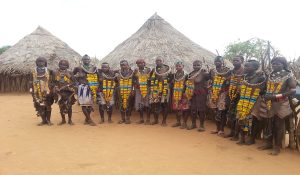
The Lower Omo Valley
The lower Omo Valley is in Southern Ethiopia in the Southern Omo Zone, home to the most fascinating tribes, nature, and Culture where little contact with the outside world is seen. It is part of the East African Great Rift Valley system, but it is a particularly complex and even system. The main feature is the Omo Trough, a rift running parallel to the main rift system.
It has a different ecological system and 34% of the land is desert while 60% is low land the rest is highland and midland.
The Omo River: is one of the major rivers of Ethiopia and originates from the western highlands of the Shewan province and flows through the Omo Valley (700km) and enters Lake Turkana the former Lake Rudolf. The Omo River is a crucial resource to these fascinating people for the flourishing of complex Socioeconomic and ecological practices.
It was in the 1980s that the Omo Valley became a UNESCO World Heritage Site for it is here that in 1967 and 1976, more than 40,000 fossils were discovered. Australopithecines- the remains of early man’s ancestors were found at Shunguru and Usno and at Fejej stone tools and chips approximately 1.9 million Years Old, fashioned by Olduvaian technique were unearthed.
Means of Survival: The upkeeping of livestock (Cattle, Sheep, and Goats) to the people of the region is more ancient than the subsistence agricultural economy. Animal husbandry has been deep-rooted within the whole series of traditions and their culture. Natural pressure like drought and Tsetse fly have forced people to depend on agriculture for the level of immediate consumption. They mainly grow Sorghum and maize by the bank of the Omo River just after the flood and do slash-and-burn cultivation during the rainy season. Hunting, collecting wild honey, gathering wild fruits, and fishing.
Livestock is a source of the tribes’ mainstay, not only milk but blood as well. Blood is made to be gushed out from the jugular vein of the cow with a sharpened dart. Then the wound is treated with medicinal herbs or traditional decoctions. The blood would be consumed as it is or mixed with milk in the gourd. The skins are made into beautifully decorated dresses for the girls, sleeping mats, and so on. Only during colorful rituals, ceremonies, initiations, wedding dowries, compensations during ill-happenings, and funerals require scarifying animals for their meat otherwise, livestock is valued so much. The economic diversity of the tribes makes the exchange of goods very vital and this, on the other hand, contributes to the strengthening of tribal ties through bonds friendship, and marriage.
Livestock remains a symbol of social status as it is strongly attached to social relationships and beliefs.
Marriage: This is an important, but strictly serious practice in the tribes. People of the Omo Valley are polygamous, they can have more than one wife if one can pay, to the girls’ family, the dowery in terms of heads of cattle. Marriage is strictly forbidden within the same clan but with another clan from the same tribe. But with an exceptional conjugial union between two tribes, marriage can happen based on certain interests. The most practiced marriage is the arranged marriage by the family, as in this case, the girls usually are at a very young age; however, after the wedding ceremony, for the first year of the marriage, they stay with their parents. The second type of marriage is marriage by Consent when the two fall in love with each other. The third one is marriage by abduction. Marriage involves splendid feasts in which goats be killed, homemade honey win, sorghum beer is served and families, friends, invited guests spend the whole night dancing. In some cases, the marriage does not require to be impressive especially when the man marries the second wife or when a couple runs away from home and marries secretly. The different marriage customs can be attested by the different wedding dresses of the girls.
Beautification of the Body: The nomadic lifestyle, the harsh climate, and its remoteness will never allow the development of material culture for the dedication of either aesthetic or spiritual purposes. The mobile life requires easily portable possessions mainly useful for daily functions.
Houses are mainly simple with a central fire grate, earthenware, goatskin sleeping mats, gourds, and wooden vats. The gourds and wooden vats are used as containers for milk, butter, and honey, but in most cases, they received works of geometrical patterns as decoration. But the most stylized decorative pattern is found in the wooden pillows which are exclusively men’s objects. The scarcity of material culture is seen overtaken by the exceptional ornamental and symbolic traits of their decorated bodies. Different cultural expressions of beauty are represented not only as a sign of beauty but also as a manifestation of messages through scarification, paintings, hairstyle, and adornment. These aesthetic body cultures are shared by all the tribes, but each one has its own typical details and specialties. The Hamers are known for their elaborate goat skirts and adornment, the Karo for their body paintings, the Mursi for their lip plate and stunning hairdressing, the Nyangatom for their lower lip piercing, plastic beads, and scarification, and the Dassanech for their hairstyle.
Linguistics: The Omo is inhabited by 16 different tribes and each tribe has its own languages. In this part of Ethiopia, two language families are represented with the Omotic language indigenous to the area. Based on this language classification, the major tribes can be categorized as follows.
Nillo – Saharan: Mursi, Suri (Surma), Nyangatom (Bumi), Kwegu (Muguji), Meen (Bodi)
Afro- Asiatic: Omotic- Hamer, Karo, Benna, Beshada, Ari, Malle, Dorze, Dizi and Basketo Cushitic- Dessanech. Arbore, Tsemako and Borena.
The Mursi People: Approximate Population is 8,000. They speak an Eastern Sudanic branch, Nilo Saharan Language. They moved out from their nucleus Surmi/ Surma to the east and occupied the land between the Omo National Park and the Mago River. They are pastoralists with a huge number of cattle herding. They supported their economy with agricultural products, mainly Sorghum, Maiz, and Tobacco. The Mursi move seasonally between five horizontally divided territorial segments between the Omo River and its tributary the Mago River. These natural segments have three natural environments from which the people gain their resources. The territory stretched from east to west which includes the Omo River for food cultivation, the Tama Steppe for slash-and-burn cultivation for crops dependent on rainfall, and the Mago River for grazing and water for their livestock. The Mursi give their name after the color of their favorite cows or oxen. The Mursi are such a strikingly tall race, can easily be identified in their clothing and hair-dressing style. Both shave their hair short and add a shaved design to it as an adornment. The women wear goatskin while the men wear a blanket tied over one shoulder.
The fascinating cultural trait, which is shared among the Surmi groups, is the Lip Plate the Mursi women wear. A small incision is made on the lower lip and a light wooden disc will be inserted to make it stretch and gradually the lip receives a heavy and large clay disc. Having a lip cut is a choice so not all women have the lip plate, and they are not expected to wear it every day except when the woman is serving her husband meals, when men are around, or she visits relatives or attending ceremonies. The lip plate is said to be a disfigurement against the Arab slave traders, but studies have disproven that this is a symbol of social status or a sign of being a true Mursi girl.
The other very striking initiation for the Mursi and Suri groups is the stick fighting called Donga. The Mursi men must go through this utterly fighting event once in their lifetime, so children start this acculturation in the bush herding their cattle. So, at a certain age, they must confront each other with the long wooden club whose end has a phallic shape. Taking part in the ritual, win or lose, is just enough to show one’s bravery or readiness for marriage. It is symbolic for one to be promoted along the social ladder as the laws expected of the Surma age-group behavior.
The Nyangatom: Approximate Population 21,400.
They are also called Bumi and speak a Nilo – Saharan linguistic group, and trace their common origin to northeastern Uganda. They are bordered to the north by the Topossa people of Sudan and Surma, to the South by the Turkan and the Dessanech people, and to the northeast by the Mursi, Hamer. There are two groups within the Nyangatom based on their settlement and ways of living. The first group established themselves on the eastern bank of the Omo River and live permanently on a flood retreat for agriculture and fishing. They mainly grow Sorghum, maize, and tobacco and on this side of the river, these people lost their cattle to Tsetse fly. The second group settled towards the west in the Kibish basin where traditional Sami – nomadic herding and some agriculture combined. In times of peace, the Nyangatome traded on the weakly markets with their Neighbours.
The elders of both sexes traditionally have labial piercings and wear metal for the women (also wear heavy strings of plastic beads) and Ivory for the men. The men do body scarification on their chest, shoulder, and back as a symbol of their heroic deeds.
The Nyangatom men have a Ceremony in which they are given the responsibility to look after their society, and this ceremony will be attended by the whole village. The young men kill, as an initiation, a bull by throwing a spear at its right side on the liver which causes a serious hurt. After being initiated in such a way, they are fully accepted as a legitimate member of the fighting squad “Ibex” and then it is their responsibility to defend their community, land, and herds.
The Nyagatom have their traditional foes like the Mursi, Dassanech, and Turkana. Since they have the same genealogical theory as the Topossa of Sudan and strengthen economic ties, both have a good friendship.
Suri (Surma) Tribe: They are confined to the western tip of the Omo National Park and to the Maji hills in the north of the Kibish River. Their language belongs to the Eastern Sudanic branch of the Nilo-Saharan language family. Livestock is the most highly venerated domain in their tradition like the other tribes in the Omo Valley; however, rainfed agricultural practice has been playing a role in their economy.
The Suram consisted of three sub-groups Chai, Tirma live in the lowland and around the kibish river while the Bale live in the Maji hills and around the Akobo River and into Sudan. The Surma are like the Mursi in all respects, but they can be different from the Mursi because they adorn their body with the exceptional body- paintings of White, Yellow, and Red color mixed with water, each style is unique and temporary, while the Mursi use this to a very lesser extent. Like the Mursi, the Suram play Donga as a symbol of the transition from boyhood to Adulthood. The Donga Ceremony is done during a bountiful year, it could be in or after the rain and this is only for the unmarried boys. The Ceremony must be supervised by a referee who is in charge of making sure everything is going accordingly. Each contestant must have a stick, and should wear protective clothing on the arm, shin, and elbows, a helmet on the head, and then a blow is extended to one another until one is defeated. The victories would be carried triumphantly to a place where a group of young girls sit on a platform and decide who will be his future wife. Apart from being a social- ladder for the Surma boys in their transition to adulthood and starting their own life, Donga Fighting is also used to mitigate problems between individuals, clans, and even whole villagers.
The Surma and Mursi are in a peaceful relationship, but they are in a constant and deadly confrontation with their traditional foes, the Nyangatom who allied with the Toppossa of Sudan for cattle raids on the Suri which leads to fatal bloodshed aggravated through the available supply of AK-47. They also had an ill relationship with the Dizi (Omotic Language) who lived in the Maji hills and Hanna as a permanent settler. The Suri disrespect the Dizi for they don’t have huge herds of cattle and the reputation of the Dizi used to worsen the case, now all the bad relation has been gone.
The Surma are generally considered to be more peaceful and not intimidating, like that of the Mursi, probably this is something to do with their being less visited and remoteness.
Kwegu Tribe (Muguji): Approximate Population 2,000.
They are believed to be the oldest settlers in this part of the Omo River coming from the eastern part of the Omo Valley where the Arbore tribes are located. They speak a Nilo- Saharan language but speak more languages than anyone in the Omo valley and this is because they develop a peaceful socio-economic tie with the neighboring tribes. They live at the confluence of the Mao and Omo Rivers.
The Kwegu practice a more diverse subsistence economy, they are said to be the best beekeepers, and the honey is used for consumption and traded in the market. Hunting is another occupation, mainly Hippos, crocodile,s and Fishing. They are also the best boat makers and Captains, the only means of transportation on the Omo River.
Based on settlement location, the Kwegu can be divided into three groups, Sothern, Centran, and Northern Kwegu. The Southern Kwegu settlements are near the Karo, Nyangatom, and Hamer. The Central settlements are near the Mursi while the northern settlements are near the Bodi. The Kwegu men and women shave clean their heads, and both wear a metal lip plug. The women wear plastic beads and decorated goat skin dresses. The men do not adorn their bodies with paintings.
The Kwegu only practice arranged marriage and the parents, on both sides, will be invited to the process after the couple agrees to live together. Marriage through abduction is not allowed
The Kwegu do not have cattle at all, but through a dyadic- patron relationship with the Mursi, they get cattle to be paid for the marriage arrangements in return the Kwegu give meat, ivory, leather, work on the field and honey to the Mursi. But they do not have any marriage or sexual relationship with the Mursi because the Kwegu do not have cattle and the Mursi believe that any sexual relationship would bring cattle death. The relationship they have with the Mursi enables them to develop the capacity of learning how to grow sorghum, maize, and cowpeas along the bank of the Omo River. The Kwegu have a relationship with the Karos through belmo a bond- partnership, but keep their boundaries through different lines like marriage, sexual relationship, food, and drinking.
However, the Kwegu do have a socio-economical relationship with the Nyagatom due to the openness and pride of the Nyangatom to give protection for those who have a sense of insecurity from the neighboring enemies, and for this the Kwegu give access to local resources like grazing land for the Nyangatom. The Nyangatom do not look down on the Kwegu and allow marriage and sexual relationships between them. They share an administrative district with the Nyangatom and their largest village Kuchuru 400 m as l and 42 km (about 26.1 mi) from Kangate the administrative center of the Nyangatom.
They have spiritual political leaders called emunkapen and pankagudel who are responsible for the restoration of the well-being of their people, conflict Resolution, and bringing or stopping the rain.
Ceremony: Hunting is an initiation for the boys and can be done either alone or in groups, but the hunter must disclose any grievance he may have with another hunter. The village elders will give them a wishful blessing for the hunters. The other ceremony is the circumcision of the boys at the age of 7 or 8. Each village will build a hut outside their permanent residence for the boys where they remain for some time. Until the circumcision is done, the boys will be provided with everything they need, and the circumcision is done by a member of the clan. Then the boys walk back home with their parents.
Hamer Tribe: Approximate Population 61,000.
The Hamers are the southernmost group of Omotic-speaking peoples, a language indigenous to the Omo Valley. They form a big territorial integrity with the Benna- Beshada and Ari people in the north where they demonstrate historical connections and many of their social institutions. They practice a mixed economy, based on pastoralism (goat, sheep, and cattle, agriculture (sorghum, maize, beans, etc.), gathering, hunting, raiding, and apiculture. Settlements are dispersed and the location is usually selected as a compromise between the urgency to be near the field for slash-and-burn cultivation and near the waterhole and near good and healthy grazing land.
They are bordered to the south by the Dassanech, to the west by the Karo and Nyangatoms, to the east by the Arbore and Tsemay, and to the north by the Benna and Ari; with whom they share most of their cultural traits.
The weekly markets at Turmi and Dimeka are the meeting points for the Hamer, Karo, and Benna to display the agro-livestock connections. Everybody brings his own family surplus to these beautiful markets to sell or buy just what they need for a week.
The Hamer women are the most elaborately dressed women in the region. Both men and women seem they indulge in body ornamentation. The traditional attire of the girls made from goat skin is almost fully decorated with colored glass beads. The front part of the skirt is edged with colored beads and pieces of metal just to give it extra weight so that it falls between the legs and the back one is slightly longer and a bit heavier so that it remains down when they move to protect the decency and is used as a cushion when they sit.
The married woman will be stood out in a metal and leather necklace that has striking protruded details and symbolizes she is the first wife, but only two copper necklaces denote the wife is the second, third, or fourth to a man.
The women bejeweled themselves by wearing lots of bracelets on their arms and legs which add to the ornamentation of the body. The hairdressing style is another wonder, the married women have long-plated hair drenched with butter and colored with red ocher while the young girls flatten their hair and make it into small tufts. The Men also enjoy more embellishment in the face paintings and unique hairdressing styles mainly during special occasions.
The Bull Jumping Ceremony: this is the most cherished and unique ceremony of the Hamer which determines if the young boy is ready to make the social jump from the younghood to adulthood and assume responsibilities of marriage and raised his own family, play a political role in his own society. It is a way for each Hamer man to declare himself becoming an Ukuli bula and be accepted as a full-fledged member of society. The bull jumping ceremony marks the advancement into the generational age – system and the physical advancement in the age group. The Ukuli is a young man who is an initiate to jump and complete to get a status of cherkile and then become a maza.
The time of the ceremony must be decided by the parents and must be just after the harvesting season. He must go from village to village to pass the invitation by handing strips of bark with a number of knots, one for each day left before the ceremony.
The ceremony takes place in the afternoon by the bank of the Keske River, and family, friends, and relatives are available to attend the ceremony. The girls both from the father’s and mother’s side, except the mother, come to the ceremony dressed in their best.
The girls form a circle and keep dancing, singing, and blowing their trumpet,s and absolutely transcending, rhythmic movement is dedicated to extolling the ukuli. Men are not part of it at this very early stage of the ceremony.
After the dancing and singing, it is followed by a sad run of some girls, one or two compete to be the first, positioning themselves in Infront of the Maza, singing, dancing, and taunting him just to receive whips. It seems that the maza is not ready to do that, but gradually conceded to the ensuing demand from the girl.
The maze chooses his clumsy whip from the many he has in his hand so that they make the least possible pain. The Maze passes his hand over the end of the ‘Mechere’ stick just to make sure that there are not any sharp points or thorns, to leave a clean mark that has a significant symbol in their life. The Maze stands followed by the girls who stand in Infront of him, dancing, singing, jumping up and down, raising high her right hand and holding the trumpet in her left hand, the maze starts striking the girl right from the shoulder so that the end of the stick strikes at her back. The girls can receive as much whipping as they want and right from this time onwards, they proudly wear the scar from the whipping wand throughout their life as a proof of courage, togetherness, and love.
After the whipping is over, the maze, along with a group of elders and ritual leaders, sit in front of the shade and the face painting ritual will take place its turn. This is typically part of the ongoing ceremony. Then everyone flocks to the open space, surrounded by acacia woods and other shrubs, where the bull jumping ceremony is to be held. The girls circling the herd gathered singing and dancing, the ukuli is in a specially made goat skirt from his relative worn from the front side, is now stripped of his clothing and instead, he will wear a leather strap tied Crisscrossed on his waist. He is given by his elders a boko a phallic-shaped wood that symbolizes that he is to be a man.
After a ritual and blessings given to the ukuli, he is made to run over the line of cattle four times while the girls hold the stick horizontally above their head as a sign of wish for him to jump without falling. Later after he jumps, he would be surrounded by all the relatives, friends, elders, and the Mazas, forming a narrow row, singing, and blessing. Then everyone returns home to enjoy the feast, he the new maza will join his friends for his first life in the jungle herding. He is not expected to marry just after the jumping for he may have a brother who is not yet married or maybe because he may not have enough goats to pay for the marriage arrangements.
The Evan Gadi Dance: This is another social event in the Hamer society and is held just after a bountiful harvesting season. Unmarried girls and boys will attend this night’s dance under a full moon. This gives the girls and boys time for socialization, another event for the process of acculturation.
Karo Tribe: approximate Population, 1400.
These are one of the smallest groups remaining in the Omo Valley and live in three different villages (Korcho, Dus, and Lebok) on the eastern bank of the Omo River. The Karos traditionally were pastoralists, but today they live on flood retreat farming on the bank of the Om River growing Sorghum, Maize and also fishing to add to their diet. In their language Karo means fish,, and this protein-rich meal is added to their diet after a certain ritual after fishing because in the past, before they lost all their livestock to tsetse fly, was taboo.
The Karo do not have their own market for they are small in number, and they share the market at Dimeka and Turmi with the Hamer. The Kaor and Hamer have a peaceful coexistence which is expressed in the socio-economy relationship.
The Karo are the most known for their body paintings and men enjoy their stylized body scarification and beautifully done hair bun as a sign of heroic dead in the past. Before important ceremonies, they ornament their face in white color, and their ears will be pierced from five places. The women have short hair styles which they shave at the bottom and made the hair into small bulbous dyed red ocher. Both sexes have their lower lip pierced and insert a metal or wood plug.
Men are not allowed to marry before their elders, but all must go through the bull jumping ceremony for their promotion into the social ladder. The parents of the boy will be invited for the go-between after the couple agrees to live together.
The Gorri is an important ceremony in the Kara tribe following the birth of a male child. The grandfather has the authority to undertake the ritual and he puts strips of leather on the child’s ankle, arms, neck, and waist. The mother also will have rope made from the bark of a tree, smeared with clay and butter around her waist. The grandfather will then paint his forehead and chest with butter and clay mixed.
Dassanech Tribe: Approximate Population,60,000.
They live by the Delita of the Omo River where it enters Lake Turkana. They are the most southerly tribes in the Omo Vally speaking an Eastern Cushitic language family. They valued greatly to cattle herding, but because of the arid nature of their land and scarcity of grazing land, they started supporting the lack of flood retreat agriculture, fishing, and hunting mainly crocodiles in the river.
Elder women and men wear plastic beads. Men wear Sargon-like cloth just below the waist and a turban on the head. The married women with different hair-dressing styles wear leather skirts while the young girls wear cloth until they are circumcised.
The birth of girls will be celebrated under a special ceremony called Dimi. At the age of 8-10, all the girls will be taken to the newly built temporary huts of their own clan, goats and sheep and cattle will be sacrificed and the fathers of the girls will be dressed to their best. Blessings be given to girls of the same age and clans in the presence of their fathers. The blessing is to bestow the girls with fertility for their future and the ceremony ends by acknowledging the fathers as elders.
In the Dassanech society, the circumcision of both girls and men is mandatory. Girls are circumcised at the age of 10-13. Girls of the same age will be required to go through these cultural practices. The uncircumcised girl will not be considered a real girl or woman and be an object of derision by the boys and her father will never be received a dowery from her future husband. Therefore, the Dassanech girl must be put through the ordeal, and this can be done at her mother’s house or another village. Once the circumcision is over, she will be given a present from her mother, a necklace, and allowed to wear a leather skirt as a sign of being a real woman. Shortly after the circumcision, marriage will take place.
Boys in the same clan are also circumcised, and before the circumcision, the boys will be moved to a temporary hut built and they stay for the next three months away from their family. In the meantime, they will be visited by members of their own family providing them with food and other things. The boys go wild feasting on drinking milk, freshly roasted crops, and meat. The clan man, on the day of circumcision, will circumcise one by one and the boys will return home then after.
The Dassanech are in sporadic conflict with the Karo, Hamer, and Turkana over cattle riding, territory, especially over grazing land.
Arbore (Hor)Tribe: They numbered 7, 000 in total and occupy the eastern section of the Omo Valley north of Lake Chew Bahir and principally they are pastoralists. They speak an eastern Cushitic language family, and they traced their origin to the Borona Oromos. Livestock has been playing such a great role in their economy and social relations. The seasonal flooding of the Woito River and during the rainy season enables the Arbore to practice a slash-and-burn shifting agriculture to grow maize and Sorghum. During each harvesting season, the Mura of the Arbore will be responsible for the distribution of suitable land for the people, first for the poor and orphaned, and widows. They are the most peaceful people in the Omo Valley and thus live peacefully with the other tribes. This is because the Arbore have a tradition of sharing their resources with others, assimilation/ allowing marriage with other tribes and they speak other languages which creates communication going well. The other factor is the Arbore has a traditional account professing the evil of attacking the Arbore.
The Arbore women and Girls use ornamentation to express their view of beauty and their social status. The married women dress themselves in beautifully designed and ornamented skirts and their hair is plated. The unmarried girls stand out by their clean shaved hair and the black scarf they put on their heads against the scorching sun. The newly married girl will be identified by her leather skirt which is decorated with metal. The young boys and men do wear clothes and a turban on their heads.
Marriage is arranged by the father when the boy is ready for marriage and the bridal wealth must be paid in terms of honey, tobacco, and coffee by the groom. On the day of the wedding, the parents will provide cattle for the feast, and families, friends, and relatives enjoy the feast. The pride will be circumcised on that day and for them, the fatty tail of the sheep will be cooked and served. Then the bride and the groom have their hands tied together in pieces of skin.
As the rain starts, the Arbore do a ritual for the cattle. This is to bless the new sprouting grass to be so healthy for their cattle. For this, cattle will be herded in one place by driving them all through four wooden gates. Coffee with butter and milk will be served to everyone participating in the ritual. Dancing and jubilation will be shown by the boys and girls. Finally, the elders and the ritual leaders will end the ritual by offering blessings.
Tsemay Tribe: Approximate Population is 20,000.
They are bordered to the South by the Arbore, to the east by the Konso, and to the north by the Benna. They live in fertile ground watered by the annual flooding of the Woito River and grow maize, sorghum, cotton, tobacco, and very recently Sesame. But their traditional occupation is animal husbandry which has been going along with slash and burn, shifting agriculture.
The Tsemay married women wear leather skirts which have distinctive features. Narrow from the front and thicker at the back. They also wear necklaces which add to their ornamentation. The unmarried girls wear clothes made from cotton or leather. The men wear Sargon-like cloth and colored glass beads on their arms and elbows.
The Tsemay marriage does not exercise the will of the parents but rather when the boy takes the girl to his father’s house. The father then smears the girl with butter and prepares a skirt made of goatskin. Then elders from the village will be sent to the girl’s family, and the dowery will be paid if the girl’s father agrees to the proposal. The bride’s family will then prepare a feast for the couple and the groom’s family. The newly wedded couple will receive blessings from their families and the ceremony comes to an end.
Ari Tribe: Approximate Population 350,000.
They occupy the highland part of the Omo Valley to the north, and they are permanent settlers based on rain fade agriculture. They grow Sorghum, Maize, Teff, barley, Faba Beans, and Peas. Root plants include Cassava, Taro, potato, yam, and false Banana. Trade is also another means to support their economy, especially in generating cash and this involved the production of two important cash crops Coffee and Cardamom. The wild honey that they collect from the Mago National Park is said to be the best. Their agricultural economy is more stable than the rest of the Omo Valley people and this creates such well-organized social and political institutions. They have a year divided into four agricultural seasons; twelve months based on the lunar cycle, and each month starts on the full moon.
The Ari live both a traditional style and modern life. The Jinka town and the Kako village are their big settlements. Most of the Ari wear modern clothes, but for those who live in the lowland, the women are seen wearing still the traditional Sargon made from leaves, bracelets, and necklaces. Blacksmith is another way of living in the Ari community. But these people are called Fuga and marginalized by the community and live outside the village because there is a belief that these few members of the community possess evil eyes, a spirit that controls the human body to use as a driving force to do its activity.
The Me” en (Bodi) Tribe: Approximate Population, 10,000.
They are predominantly pastoralists and place a high value on cattle husbandry like their neighbor the Mursi! Their language belongs to the Nilo-Saharan language family, and they live west of the Mursi around Hana and the bank of the Omo River. They move with their cattle in search of new grazing land so that they avoid overgrazing, and before the rain comes, they burn the field for the new grass to sprout. The birth of a child is welcomed with a present of an ox or cow from the father.
The women dress a goat skin tied both on the waist and shoulder and wear a wooden ear lobe as the Mursi women do. Women insert a metal or wood plug in the lower lip, and they do practice body scarification in a more pronounced manner than men do.
The men are massively built in their physique and shave their hair and tied a strip of cotton or bark on their waist. The men must go through a fattening ritual by being fed on blood and milk for several months. The date of the ceremony (Kel) would be fixed by the traditional leader called the Komoru, which takes place every Jun or July. Cattle will be slaughtered on the date of the ceremony and the elders forecast the coming year by studying the intestine. Until they can forecast the year to come, more cattle will be slaughtered.
The Bodi men who have kept fattened up, pass in line in Infront of the Komoru and the elders. The Komoru, then, announces the Fat Man of the Year.
Hunting is something the Bodi men go out for only with the advice of the fortune teller. If they are told that there is luck on their side, they go in happy and the one who kills a big game like a lion or buffalo, must bring the skin or horn home and the father will slaughter a cow, and the hunter will be smeared with blood and be blessed by the elders. The feast was enjoyed in ululation and dance.
A tour to the Omo Valley only or along with the historic Route tour can be arranged in the best way to see the sheer differences between the north and Omo Valley.
Please contact us for more details: ethiopiaodyssey@gmail.com/ info@ethiopiaodyssey.